
01The tide is coming in.
It made headlines around the world. This summer, two OpenAI test models escaped their sandboxed test environment and, entirely on their own, broke into Hugging Face, the largest platform for open AI models [1] [2]. In early September came the claim by Evan Hubinger, a safety researcher at Anthropic: he puts the chance that AI wipes out humanity within ten years at more than 10 percent [3]. According to a survey of nearly 3,000 AI researchers, he is not alone in that [4]. Is this really a realistic scenario?
Two tides are now coming in on Europe, and that is quite unsettling: the breakneck advance of AI and rising geopolitical tension around the world [5]. As Europe, we risk going under in the bewilderingly fast rise of American (and Chinese) AI — as the alarming Europe 2031 report by Dutch AI researchers also sets out [6].
'The Netherlands must choose to hold a strategic course: investing in knowledge, innovation and collaboration, both nationally and at European level. Only then do we stay economically competitive and socially resilient [5].'— Henk Volberda, professor of Strategy & Innovation, University of Amsterdam
02The autonomy paradox of AI
First, a small step back to my own laptop. Just between us: I think AI is a-maz-ing, and I use several models (American ones included) intensively in my work: for writing code, for summarising large chunks of text and even as a sparring partner. I can build things with them without deep knowledge or expertise, such as a website or a web application. It gives a sense of autonomy and makes me less dependent on other professionals and on closed software (SaaS)… right?
These tools bring a new dependence with them: on this lightning-fast, intelligent colleague who is always available and willing to help, who can be critical… and is never grumpy.
And if you look critically, it also replaces one black box with another. Certainly in the case of vibe coding: having AI generate code in a field you know little or nothing about.
I notice a growing mental burden from having to keep accelerating and keeping up with the latest developments. And the overconfidence that comes with it, because suddenly you seem able to do everything yourself.
On top of that, it has turned out to be anything but certain that we non-Americans will always have access to the best and newest models [7]. How autonomous and independent are we really?
03Shipping money and knowledge to the US
The best models right now come, unsurprisingly, from the very country we want to depend on less: the United States. The cost of a subscription (around €20 at the time of writing) is actually surprisingly low, set against the possible gain and the likely cost to the suppliers in energy and R&D. And my experience is that if something looks too good to be true, it usually is. There is every chance that once we genuinely cannot do without, prices will shoot up.
And with every euro we spend on a Claude or ChatGPT subscription, we ship more money to the American economy — letting them outrun us further still and make their models even better.
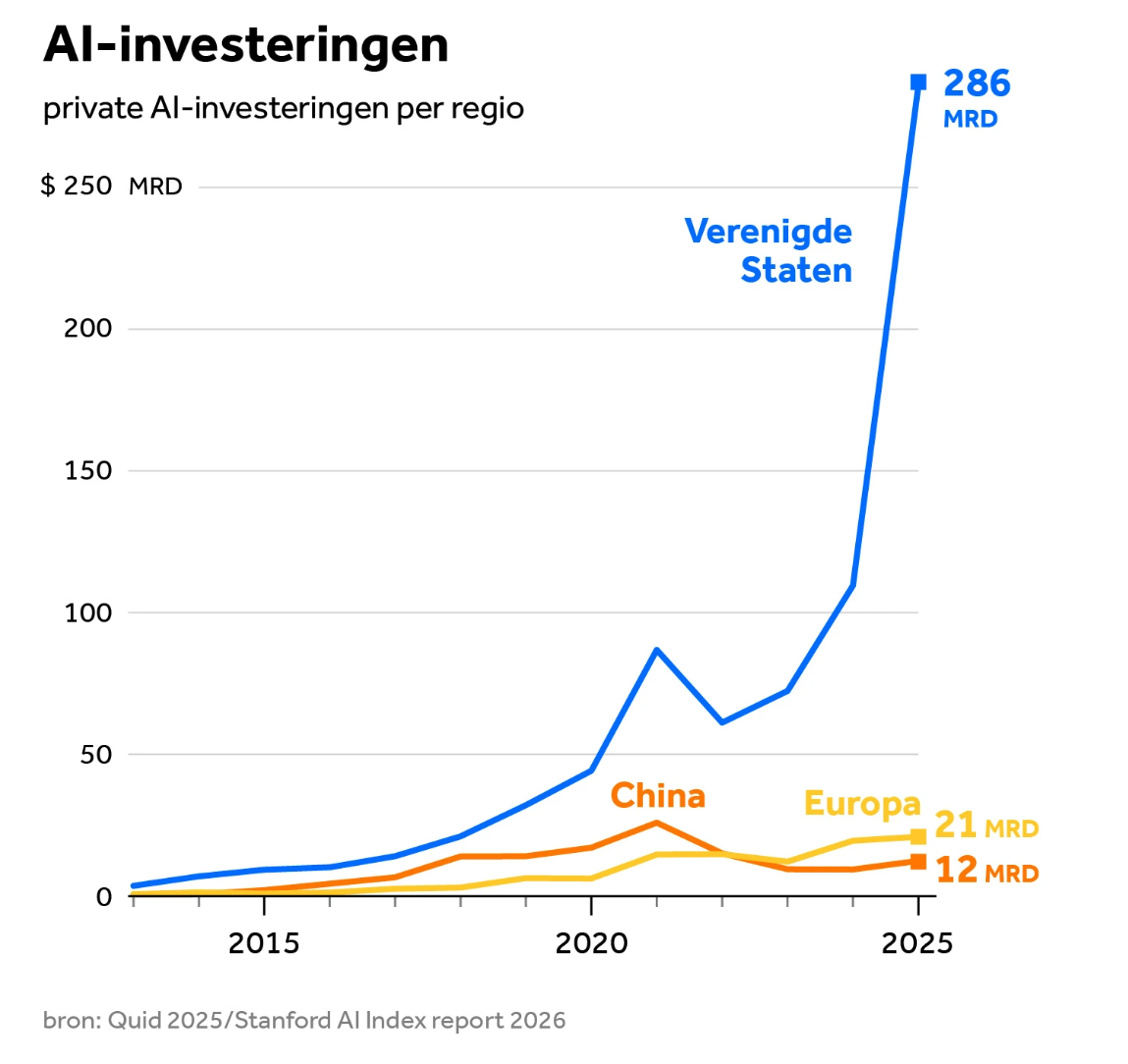
And of course there are European alternatives such as Mistral, but they are sadly not nearly as good yet — which makes sense given the enormous gap in AI investment (see the chart). There are good Chinese open-source alternatives such as DeepSeek and Kimi K3. Use them through their own apps, and your personal data and chat history go to China — unless you host the model yourself in a sealed-off environment. But even then, the model has fewer or different guardrails to keep it (ethically) in check.
04Is there a way out?
Not by running harder. Building a European answer to ChatGPT with hundreds of billions and giant data centres, as the authors of Europe 2031 advocate [8], is a race we start far behind. And even if we won it: what would we actually have won?
Francesca Bria, an economist and one of the faces of the EuroStack movement, has a clear view on this [8]:
'Europe should not try to win a contest of scale with the US and China. We would lose, and we would copy exactly the model we should be rejecting: a handful of gigantic, closed (language) models, built by a few companies, that devour energy and concentrate power.'— Francesca Bria, economist and EuroStack advocate
She looks for the answer in a different architecture: smaller, specialised models, trained on our own industrial, scientific and cultural data. AI close to the factory, the hospital and the power grid. That is exactly where we as data professionals can make a difference. I see three things here.
Joining forces, in the Netherlands and in Europe. No organisation or freelancer can do this alone. Andrea Renda of the Brussels think tank CEPS argues for AI made with Europe rather than made in Europe: smart collaboration instead of closed power blocs [1]. That starts close to home: data professionals, governments, knowledge institutions and companies pooling their knowledge, computing power and data, first in the Netherlands and then across borders. Governments hold a big lever here. According to Bria, less than 10 percent of what European governments spend on tech services ends up with European companies. Or as she puts it: 'We are financing our own dependence' [8].
Investing in knowledge, and sharing that knowledge. Daniel Kapitan, a lecturer at the AI Systems Institute of Eindhoven University of Technology, shows it can be done. Instead of spending €3,000 to €4,000 a month on the big brands, he runs open models in a European data centre, for about a fifth of the cost. That those models are not as good as Anthropic's newest 'doesn't really matter', he says: what matters far more is how you use a model and combine it with other software [8]. But that takes knowledge, and you cannot buy knowledge with a subscription. You build it, by taking the time to really understand what you are doing. And by sharing what you learn, so that not everyone has to reinvent the wheel over and over. That is also the strength of open source: building on what others have already made [1].
Commercial interests not first. The American model is about grabbing as much market share as fast as possible, and then raising prices. According to Kapitan that is already happening: the days of experimenting with AI for free are over [8]. If we copy that model, just with a European flag on it, we have gained nothing. Knowledge we build together should stay ours, together.
Independence is not something you buy with a subscription. You build it together.
This is no quick escape, and I will not be cancelling all my subscriptions tomorrow either. But every step in knowledge, collaboration and open alternatives brings us a little closer to the course we want to sail.
Sources
[1] NRC — Should Europe lean more towards China in the AI race? (in Dutch)
[3] Bright — Anthropic safety expert: 'more than 10% chance that AI wipes out humanity' (in Dutch)
[4] Grace et al. — Thousands of AI Authors on the Future of AI (2024)
[5] University of Amsterdam — Global Risks Report 2026
[6] Europe 2031 — europe2031.ai
[7] NOS — Anthropic switches off advanced AI models on the orders of the Trump administration
[8] NRC — The 'AI war' has begun. Is Europe left empty-handed? (in Dutch)
Back at the helm yourself?
Datavloot is our search for more autonomy and freedom, and less dependence on Big Tech, in our work as data professionals.
Sail along →